
VIDEO
CONTENT
QUIZ
MATERIALS
Introduction
Physical Characteristics
Habitat and Distribution
Diet and Feeding Habits
Behavior and Lifestyle
Reproduction and Life Cycle
Conservation Status
Interesting Facts
Koalas are a beloved marsupial native to Australia, known for their unique appearance and tree-dwelling habits. Often mistakenly called “koala bears,” they are not bears but are more closely related to other marsupials like kangaroos and wombats.
Physical Characteristics of Koalas
Body Structure and Size
- Overall Build: Koalas have a small and compact body, complemented by short limbs. Despite this, their body is lean and muscular, particularly adapted for climbing.
- Size Variations: They typically measure between 60 to 85 cm (23.6 to 33.5 inches) in length. Their weight can vary significantly, ranging from 4 to 15 kg (9 to 33 lbs), with males being substantially larger than females.
Limbs and Dexterity
- Limb Length and Strength: Koalas have long and strong limbs that are nearly equal in length, a feature that supports their weight and aids in climbing.
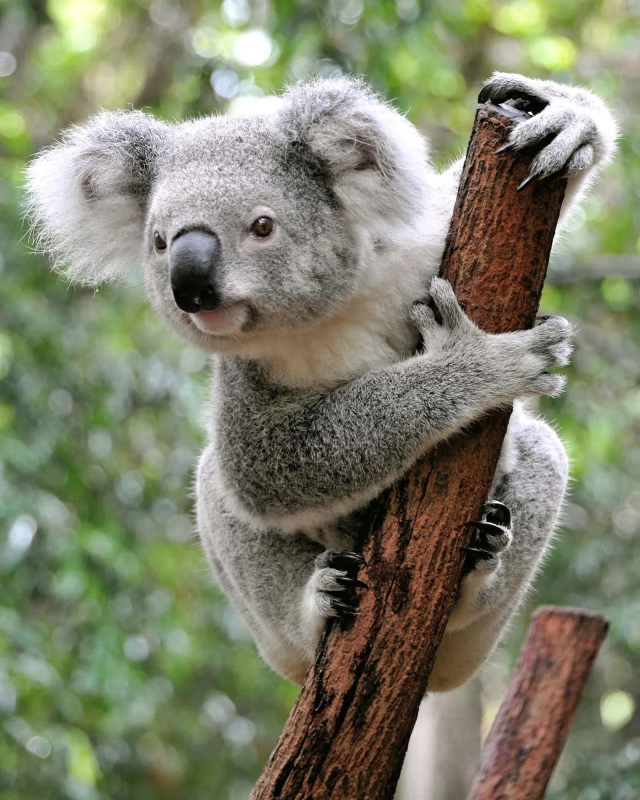
- Paws and Claws: The front paws are equipped with two opposable digits, which are essential for gripping branches and foraging eucalyptus leaves. Their feet have tough, textured skin and long, sharp claws, providing necessary traction for climbing.
Head and Sensory Organs
- Head Proportion and Brain Size: Their heads are large in proportion to their bodies, but their brain size is smaller relative to other marsupials. This reduced brain size is an energy-saving adaptation, linked to their low-energy diet.
- Eyes and Vision: Koalas have small eyes, and their eyesight is less developed. However, they compensate with a highly developed sense of hearing and an acute sense of smell, crucial for detecting predators and selecting eucalyptus leaves.
Fur and Skin
- Fur Texture and Coloration: The thick, woolly fur varies from light grey to brown. It serves as insulation against temperature extremes and provides waterproofing during rain. The fur on their rump is especially dense, acting as a cushion on tree branches.
- Regional Differences: Southern Australian koalas are generally larger with thicker, often browner fur, an adaptation to the colder climates they inhabit.
Gender Differences
- Size Difference: Adult male koalas are noticeably larger than adult females.
- Female Pouch: Female koalas possess a pouch on their abdomen for nurturing their young. The pouch opening is oriented towards the bottom to protect the joey while climbing.
Tail and Facial Features
- Tail and Body Color: Koalas are almost tailless, with a stout body predominantly gray in color, contrasting with a paler chest.
- Facial Characteristics: They have a broad, rounded face with a wide, leathery nose and large, fluffy ears, enhancing their auditory capabilities.
Koalas are found in Australia, specifically in the eastern and southern regions, inhabiting eucalyptus forests and woodlands. They are highly adapted to a life in the trees, with strong limbs and opposable digits for gripping branches.
Koalas have a highly specialized diet, feeding almost exclusively on eucalyptus leaves. They possess a highly developed sense of smell to select the most nutritious leaves and have a slow metabolic rate, which conserves energy but limits their diet to a few high-nutrient eucalyptus species.
Koalas are solitary and nocturnal animals. They spend most of their time sleeping (up to 18-22 hours a day) in the forks of trees. When active, they are usually seen eating or moving to new feeding areas. They communicate with various vocalizations, like snores and bellows.
The breeding season for koalas occurs typically from September to March. After a gestation period of about 35 days, a single, tiny joey is born and immediately climbs into the mother’s pouch for further development. Joeys stay in the pouch for about six months, after which they ride on their mother’s back and start to feed on ‘pap’ (a specialized form of the mother’s feces) and leaves.
Koalas are currently listed as vulnerable by the IUCN. Threats include habitat destruction due to urbanization and agriculture, diseases like chlamydia, and climate change impacting their food sources. Bushfires also pose a significant threat, devastating large areas of their habitat.
- Fingerprints: Koalas have fingerprints remarkably similar to humans, so much so that they can be mistaken for each other in forensic investigations.
- Water Intake: They rarely drink water, obtaining most of their moisture from eucalyptus leaves.
- Eucalyptus Toxicity: Despite the toxicity of eucalyptus leaves to most animals, koalas have a specialized digestive system to detoxify the poisonous chemicals.
- Social Structure: While mostly solitary, koalas have a complex social structure, with dominant males having exclusive access to females in their territories.