Skip to content
VIDEO
CONTENT
QUIZ
MATERIALS
Quick Facts
Key Features
Ossification
Variations
Surface Anatomy
Clinical Correlates
Quick Facts:
- Location: Positioned in the hand.
- Bone Type: Classified as a short bone.
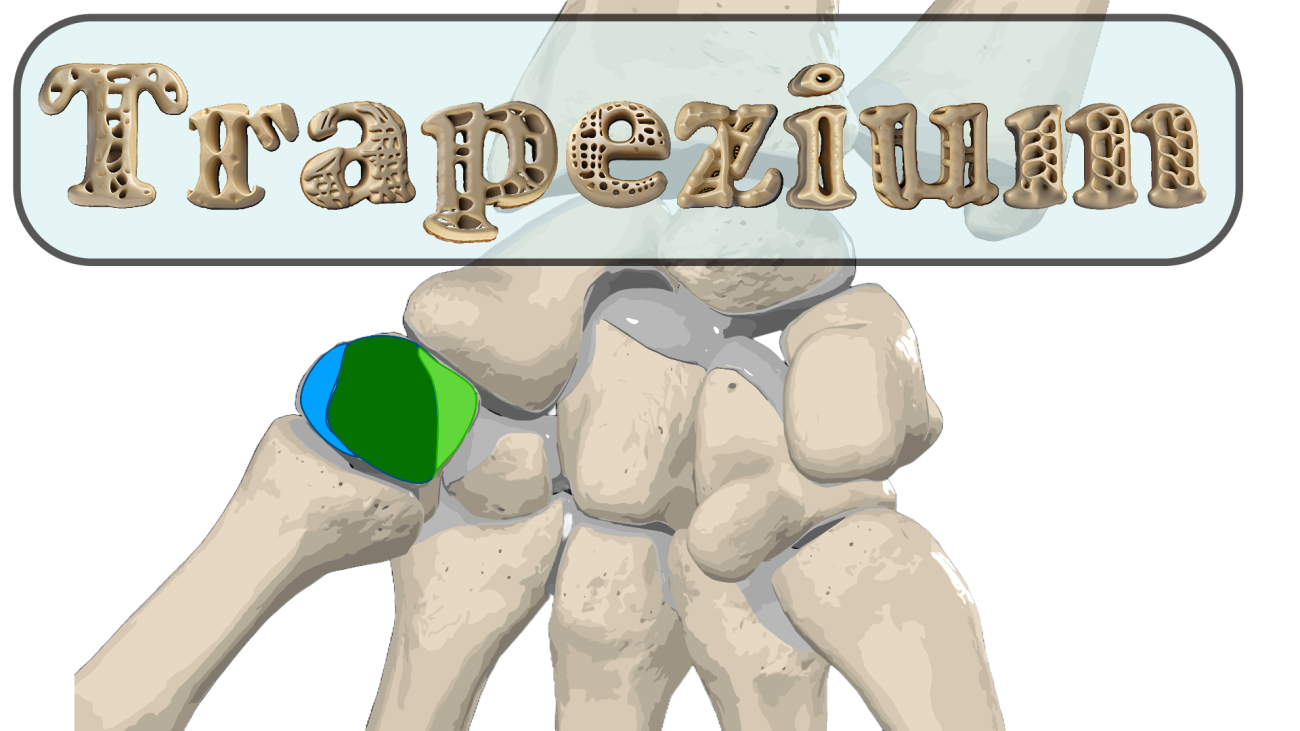
- Key Features: Includes a tubercle, palmar and dorsal surfaces, and articular facets for scaphoid and trapezoid bones.
- Articulations: Connects with the scaphoid, trapezoid, and the first and second metacarpal bones.
- Arterial Supply: Primarily supplied by the radial artery.
Key Features & Anatomical Relations:
- Shape and Position: Quadrilateral-shaped, located in the distal row of carpal bones.
- Parts: Features a prominent tubercle.
- Surfaces: Comprises palmar and dorsal surfaces.
- Landmarks: Includes articular facets for scaphoid, trapezoid, and the first and second metacarpal bones.
- Location Relative to Other Bones: Proximal to the first and second metacarpals, distal to the scaphoid, lateral to the trapezoid.
- Joints Formed: Participates in the scaphotrapezium, trapeziotrapezoidal, and carpometacarpal joints.
Ossification:
- Ossification Center: Develops from one ossification center, appearing between the fourth to fifth years of life.
- Complete Ossification: Achieved during early to middle adolescence.
Variations:
- Bipartite Condition: In some individuals, it may exist in two parts.
Surface Anatomy:
- Palpation: Can be palpated proximal to the base of the first metacarpal bone, especially during thumb opposition.
Clinical Correlates:
- Fractures: Fracture of the trapezium bone is a noted clinical condition.